Sons of Gods: Interview with Hindu Blog
Interview with S. Aruna – the author of book:
Sons of Gods – The Mahabharata Retold
First published on Hindu Blog,
Sons of Gods – The Mahabharata Retold by S. Aruna is a condensation of the epic
Mahabharata. Below is an interview with S. Aruna – to understand what new she offers
to the reader through the book, the language, the women characters etc.
1. To those who have already read the Mahabharata or know the story,
what new aspects does your book offer?
Every writer who attempts a condensation of the Mahabharata will have a certain
vision of which elements of the vast epic are essential, which less essential.
Thus each condensation is unique in itself, since each one moulds together a different
set of story elements. In my case, I was motivated to achieve three goals:
first: it should essentially be a whole, rounded story similar in structure and style
to a modern novel: that is, to bring the central story to life through the characters
and dialogue while omitting almost all of the hundreds of “side-plots”, and avoiding
the sermonising which, to my mind, detracts from the story in so many interpretations.
I also spend far less time on the details of the actual war; I don’t see the point in
describing a battle blow-by-blow, punch-by-punch. So the actual Kurukshetra war is
less than a third of the story in Sons of Gods, and limits itself to the fights between
the main heroes.
Secondly: I wanted to reveal the essential spiritual core of the epic, but without
beating the religious drum. The spirituality had to be between the lines, subtle yet
potent.
My third goal was to present the Mahabharata through a different angle by
emphasising the role of one particular character—but I’ll get to that later.

2. I have not read the Mahabharat. Will your book be completely helpful?
Yes. It will give you the essence of the story and perhaps inspire you to read longer,
more detailed versions.
It’s definitely not scholarly; scholarly styles, I believe, only distance the reader from the
characters, and I wanted the opposite: for readers to feel and be moved by the dilemmas
the characters face and really get into the story. So I use a plain yet archaic and
dramatic language; I wanted to invoke the abundance, the colour, the highly-charged
drama, the very Indianness of the epic through language. These are larger than life
heroes; nothing is ordinary for them, and I think it’s rather fun to have flowers raining
down from heaven, and arrows like hissing snakes flying through the air!
These are not Western images at all—but that is deliberate. I want readers to get into
the spirit of the epic, which means stepping into this extraordinary world where mortals
walk with gods, where a word spoken can take terrible, irrevocable effect.
4. How is the Bhagavad Gita treated in book?
It’s by necessity condensed to the essential message: Arjuna must fight, but do so with
detachment, knowing that there is no death, no killing; that he is but an instrument of a
higher power, and that his innermost Self is divine. As it is in all of us.
The Mahabharata is a book about men, yet the few female characters are powerful indeed:
the goddess Ganga, the Pandava’s mother Kunti, the Princess Amba, and of course
the Pandavas' common wife, Draupadi.
Of them all, I find Amba the most tragic, as well as the most interesting.

in Mahabharat? Does your view reflect in the book?
When we consider the women in the Mahabharata and their treatment, it’s
important not to see them through the prism of Western feminism. This is a
story set in an age and a place far removed from our own world. Different
standards were valid in that age, and it wouldn’t be fair to speak of “repression”
and “subservience” in that context. Yes, the Mahabharata is a story
dominated by men. Yes, all the great heroes are male.
And yes, there are only a few women, whose roles are mainly that of wife and
mother. Yet, how powerful they are in those roles!
There’s the goddess Ganga, who dictates the terms of her marriage to King Santanu;
there’s Gandhari, the mother of Duryodhana and his 99 brothers, who, after all the
leading statesmen and wise councillors have pled in vain for peace, is summoned
to the court to give the final word: as mother of the Kauravas, her wish is—or should be—
final, and obeyed. Kunti is revered by her five sons, the Pandavas, to the extent that
a word of hers spoken in jest is taken as an absolute command.
And Draupadi: it’s for her sake, to restore honour to her, that the entire war is fought.
There remains only Amba, who is cruelly wronged by Bhishma near the beginning
of the story; but I love the way how, after she experiences the most bitter shame and
dishonour, she rallies her forces, decides on revenge, and focuses all her energy and
her will on executing justice on Bhishma—even if she must die and be reborn again
and become a man in order to do so. Amba is without doubt the very first transsexual
character in literature; but even with a man’s body, she remains Amba, a woman,
and it is as a woman she seeks revenge, and engages in battle against Bhishma.
In Sons of Gods I’ve tried in a small way to honour Amba; yes, she makes mistakes,
but in the end truth wins out and she finds peace.
As for Draupadi: she’s the most assertive of all the women; quite the diva,
in the way she orders her husbands about! She’s not a female character I particularly
like; she’s proud and vengeful and very bossy, and that’s how I’ve portrayed her.
But another author, Chitra Banerjee Divakaruni, managed to portray a
different side to Draupadi in her book Palace of Illusions, so that I ended up
understanding and even liking her! We must remember that in Hinduism, the so-called
female attributes of selflessness, forbearance and gentleness are seen as positive,
whereas the so-called male characteristics of assertiveness, domination and control
are considered negative, being traits of the ego that must, eventually, be surrendered
to God. This why Yudhisthira, the eldest Pandava and rightful king, embodies the
more feminie qualities of forbearance, forgiveness, kindness. He refuses to wage
war with his enemies even when egged on by his more belligerent brothers. In modern
terms, he’d be called a wimp. Yet it is clear that those very qualities are the ones that
define Yudhisthira as great.
Siva and Shakti, male and female energy, are seen in Hinduism as
complementary, each valuable in its own right, each necessary for a harmonious
life on earth.
God can be mother as well as father, and the Mother is, finally, divine. Ideally,
women are seen as the invisible backbone of society; it is that backbone that
holds society upright, and when it falls, so too, according to Hindu thought,
does society. Of course this ideal, humans being as flawed as they are, is
seldom realised, and women all too often trodden underfoot in India as
everywhere in the world; and women, too, can be evil, avaricious and selfish.
But it is there, a goal to be aspired to.
In Sons of Gods I’ve tried to get under the skin of the few women, so that the reader
understands their inherent, though perhaps quieter, strength.
7. What is your approach towards the character of Karna in the book?
Karna is my favourite character. In many shorter versions of the Mahabharata
his role is skimmed over; he is merely one of the antagonists, Duryodhana’s
right-hand man, Arjuna’s arch-enemy, a villain. And in the longer versions the
reader tends to lose sight of him; he is lost amid the sheer vastness of the
epic. But I’ve always been on the side of the underdog, and I love the fact that
Karna in the role of the underdog actually possesses a secret power, a power
he is unaware of. His position is pivotal to the entire story, and I was determined
to make this clear. That’s why I brought forward the scene of his conception and
began the story with his birth, as a sort of prologue.
It’s to say: watch this guy. He’s important. Don’t forget him. He’s a great
character. Flawed, but honourable to his fingertips.

the book treat this statement?
I tried to make it clear that Dharma and Adharma are not black and white
concepts. It’s not like a Western movie, with the baddies and the goodies
clear-cut and indisputable. Many of the heroes on the side of the villains are
fine men, who know Dharma—take Bhishma, and his dramatic call to Krishna
to kill him, for he longs for death by the hand of the Lord! And the Pandavas
are only able to achieve victory in the great war through means that are on
the surface adharmic, against all the rules of chivalry—and they do so with
the blessing of Krishna, the Lord. So I think the essence of the story is not so
much Dharma versus Adharma but Detachment; this is also the essence of
the Bhagavad Gita. It’s not the action itself that is important, but our attitude
as we perform the action that needs to be done; our duty, which arises through
the necessity of the moment.
9. How long did it take to complete the book? How was the experience like?
I began writing my own version of the Mahabharata in 1975, when I was 24, and
in India. I did so for my own enjoyment; it was supposed to be a composite of
all the different versions I had read, trying to mould together all the elements
I liked best, the parts that moved me most, and omitting those scenes and
side-plots that I felt were distracting. In the following decades I kept rewriting
the story, improving on it, reading other versions to see what I had missed,
paring it down, and so on. Sometimes I put it away for years at a time, but
always it came back to me. I started out on a very faulty typewriter; sooner or
later I retyped everything on to a PC and since then revising it has been
much easier. It’s very likely, however, that in a year or two I will pull it back
and re-publish it in a new, improved, revision! So you could say it’s taken
almost 40 years to write. Then I decided to put it on Amazon.
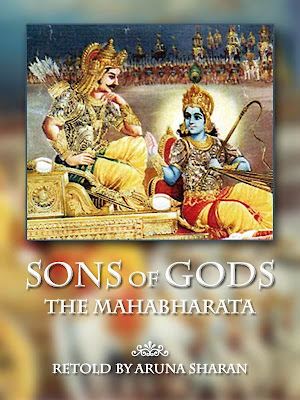
This was the first cover:

It has always been a joy to write. I wasn’t even thinking of publication at first; after all,
I was just a struggling student, not yet a professional novelist. Actually, Sons of
Gods taught me to write. I just loved getting into the story, being moved by it,
understanding the characters, finding the right words to describe my
enthusiasm. It was a very emotional undertaking, and I still don’t think the
form I ended up with is perfect—words are so inadequate! I can only hope
that readers can get behind the words to actually feel the story as I felt it.
Sons of Gods is available on Amazon in ebook or in print.



Comments