Posts

Showing posts with the label Bhagavad Gita

The Bhagavad Gita: a lifeline in a storm

Image
As it is for many people, the Gita was my first real introduction to the Hindu faith and philosophy -- or Sanatana Dharma, which is the more accurate term. Yesterday I wrote on another blog, Sadhana Day by Day (sorry - no longer live) about the experience that turned my life around forty (fifty now!) years ago, and set me on my spiritual path. The aftermath of that experience was that I returned home and turned over a new leaf completely; and the lifeline that straightened out my oh so crooked life was this little book: the Bhagavad Gita. In retrospect it seems that that path was already predetermined, and that everything was all planned out in advance that I should end up devouring the Gita as if I were starving and it was living water. Before my trip through South America I had already discovered the miracle of Hatha Yoga, and diligent practice  had sorted out many of my more pressing, physical problems: drinking, smoking and an eating disorder that had made me so fat I’d f...

Now in Print!

Sons of Gods is now available in Print -- at last! It's available on Amazon and other retailers, in paperback. I've planned this for so many years -- I can't believe it's happened! And to celebrate, I have a new review, and a great one at that, by Shelley Schanfield  a Goodreads member, There are many retellings of the Mahabharata, India's classic epic. I have read several and would recommend Sons of Gods for anyone not already familiar with this ancient tale. Taken as a whole, the Mahabharata is unwieldy, to say the least. It is filled with digressions and stories within stories that resist linear narrative. Sharon Maas's version is admirably streamlined for readers who want to get a grounding in the basic story before exploring in more detail the rambling conglomeration of myths, legends, and history that make up this massive tale. The greatest strength of Sons of Gods lies in its introduction to the complex Kuru-Pandava lineage. Understanding the com...

The Gita Series: Part One

Image
As promised, I've published Chapter 58: The Song of God as a blog page above. To understand what is happening here one really needs to have read the Mahabharata, but the Gita is important  that it has taken on a life as its own: 18 chapters of sublime wisdom, known  as a major world scripture in its own right. For Hindus it's the equivalent of the Bible. There are many translations, of course, and I certainly have not read them all in order to make a choice as to which is the best. The version I own is a translation by W. J. Johnson published by the Oxford University Press. The chapter 58 of Sons of Gods is a much condensed version of the Gita, and not a translation of a selection of verses: it's what I believe to be the essence of Krishna's message to Arjuna on the battlefield of Kurukshetra. Much as I would have loved to include the entire Gita, doing so would have broken the word limit I had set for myself and held...

More Interviews, and what's coming up

There's an interview with me today on Hindu Blog about the Mahabharata.  And last week this interview was published on Diane Dooley's writers' blog: Interview and Giveaway with Aruna Sharan.  My thanks to those blog owners.  Meanwhile, on my new blog Sadhana Day by Day the ideas for future posts are simply overflowing -- I'm very excited about putting all of this to paper!  And right here on Sons of Gods I'll be keeping my promise to highlight the Bhagavad Gita over the next few days.

Myths of Mankind: The Mahabharata, Part Six

Vedas , Astronomy and Spirituality: is the Word mightier than Stone? "In the incredible age of Indian civilisation new evidence arises from the one intact source of Indian records so far overlooked: the fact that the word may be mightier than rock. Generations upon generations have passed down the poem before it was written down, the verses remembered with uncanny precision through intricate exercise." ………............................................................................................ "Oral tradition, the words themselves, may have carved a monument that withstands the ages better than rock, that is lost when it is written down; for it goes by the ear, by the rhythm of the heart. The sound silences the mind. It stills all thought: but as the book says, make one mistake, that’s when the snake strikes: when the ear hears. Oral tradition needed no written records. If it could be remembered faultlessly for a thousand years, why not for...

Myths of Mankind: The Mahabharata, Part Five

Image
Destiny and Free Will : is Paradise open to dogs? (watch the video below for the answer!) “'You must learn to see with the same eye a mound of earth, a heap of gold, a cow, a sage, a dog, and the man who eats the dog. There’s another intelligence beyond the mind.' Krishna in Peter Brook’s Mahabharata. 'Dharma belies the Western criticism of Hindu thought: that it leaves precious little room for free will, that it binds man upon a wheel of fate, a wheel of reincarnation, rebirth; a wheel that goes round and round and round and round and round. 'Dharma offers the escape from the fate of reincarnation; it is the path detached from this world of illusion, to the quintessential truth which Hinduism seeks. “'From a western point of view it’s impossible to understand that fate, destiny and free will can coexist. Everything in the western mind says if there is fate there isn’t free will, if there’s free will there can’t be such a things as fate or destiny. The M...

The Spirit of India

"Only India has preserved the unbroken thread of the human story that binds us all.” Michael Wood, BBC documentary “The Story of India”. For 50 centuries the Mahabharata has survived as a cornerstone of Indian culture, loved by hundreds of millions of Hindus as a inexhaustible treasure-house of anecdotes, proverbs and wisdom. Its heroes are held up as standards of dharma, right action; its villains serve as warnings as to the consequences of adharma, wrong action; and it shows the grey area between these two where each individual must make a choice, and live with the results of that decision. It provides a powerful source work for themes in literature, art, drama, dance, song, and, in modern times, film. In it we find history and legend, myth and folklore, fable and parable, philosophy and religion; and last but not least, incredible romance. It’s a book of big ideas, magnificent events, simply a great story. Above all, at its core is the Bhagavad Gita, one of Hinduism’s ...

The Cover-- Revealed!

Image
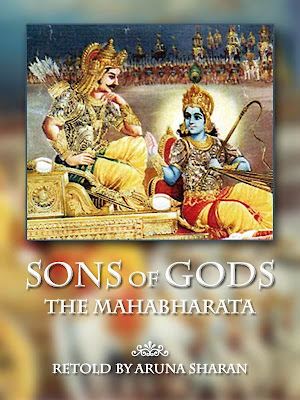
C over design: Burke-Design Cover artist: Mu Ramalingkum Thanks to Laura Burke for donating this beautiful cover design! About the Mahabharata The central story of The Mahabharata is straightforward: it’s the age-old theme of good against evil, culminating in a cataclysmic war, the Battle of Kurukshetra. On the “goodie” side are the Pandavas: five brothers “like the five fingers of one hand”, each of them sired by a god, for their mother (and step-mother), Kunti, possesses a powerful Mantra that can summon such a divine being to father her children. The eldest Pandava is Yudhisthira, a paragon of a king. He is everything the world has ever longed for in a leader: just, unselfish, benevolent, upright, peace-loving, yet, if called for, a great warrior. But is he also weak? When he is cheated out of his kingdom by his arch-enemy, his wicked cousin Duryodhana, he dithers, unsure of the ethics of war, and it takes his warrior brothers as well as Krishna, the Incarnation...