Posts

Showing posts from November, 2011

Not Just for Scholars...

Image
The Myths of Mankind video series was something of a marathon ride. In the next few weeks I'll return to discuss some of the issues brought up in the documentary. But for the time being -- if you got the impression that the Mahabharata is just for Vedic scholars, historians, archeologists, anthropologists and other terribly, terribly deep and serious people you'd be very wrong. What I've left unsaid till now is this: reading the Mahabharata is hugely, delightfully entertaining! It's an absolutely fun read, and it's amazing to see what a great sense of humour its author or authors had in composing it. Take, for instance, Arjuna's year incognito in the court of Vitara. He's been cursed by a beautiful celestial dancer -- an apsara -- to be eunuch for a year -- what better disguise! So Arjuna hangs out in the women's quarters: Arjuna, the greatest warrior, the archetypical alpha male, dressed as a woman! "... golden earrings dangled from his ea...

Myths of Mankind: The Mahabharata, Part Six

Vedas , Astronomy and Spirituality: is the Word mightier than Stone? "In the incredible age of Indian civilisation new evidence arises from the one intact source of Indian records so far overlooked: the fact that the word may be mightier than rock. Generations upon generations have passed down the poem before it was written down, the verses remembered with uncanny precision through intricate exercise." ………............................................................................................ "Oral tradition, the words themselves, may have carved a monument that withstands the ages better than rock, that is lost when it is written down; for it goes by the ear, by the rhythm of the heart. The sound silences the mind. It stills all thought: but as the book says, make one mistake, that’s when the snake strikes: when the ear hears. Oral tradition needed no written records. If it could be remembered faultlessly for a thousand years, why not for...

Myths of Mankind: The Mahabharata, Part Five

Image
Destiny and Free Will : is Paradise open to dogs? (watch the video below for the answer!) “'You must learn to see with the same eye a mound of earth, a heap of gold, a cow, a sage, a dog, and the man who eats the dog. There’s another intelligence beyond the mind.' Krishna in Peter Brook’s Mahabharata. 'Dharma belies the Western criticism of Hindu thought: that it leaves precious little room for free will, that it binds man upon a wheel of fate, a wheel of reincarnation, rebirth; a wheel that goes round and round and round and round and round. 'Dharma offers the escape from the fate of reincarnation; it is the path detached from this world of illusion, to the quintessential truth which Hinduism seeks. “'From a western point of view it’s impossible to understand that fate, destiny and free will can coexist. Everything in the western mind says if there is fate there isn’t free will, if there’s free will there can’t be such a things as fate or destiny. The M...

Myths of Mankind: The Mahabharata. Part Four

Image
Mythology and Religion "Indian mythology is like a mirror that shows their hearts' desire to all who look into it. So the Hindu in his shrine might greet you with : 'So you are a follower of this Jesus, brought his image with you! He is very nice too! Put him up there too in the shrine, there’s plenty of room!' "It is so because the original idea was never abandoned; it was merely enlarged, expanded upon for every imaginable taste. To this day though, in his heart, the Hindu really only believes in One ineffable God, creator of everything, to whom everything returns. Not the Christian father high up in heaven but inside us, everywhere, in all. Sometimes this One is known as Para Atman, whereas the individual soul is atman. Para means supreme: the Supreme Soul. "Our mind, our senses, separate us from that Soul. Our desires with which we shape the world around us distance us from the divine. So desire triggers the actions that shape reality but desir...

Myths of Mankind: The Mahabharata Part Three

Image
Archaeology (con'd) and Hinduism "The quintessence of India, her religion, has remained unchanged ever since the great poem was composed. No invader or coloniser was ever able to overcome it, and indeed many, like the Aryan invaders form the north, were overcome by it, absorbed into its generous complexities. "Jews were here since the times of king Solomon. India has the distinction of being the only country on earth where they were never persecuted. Almost every religions faith of the world was represented, like Islam in huge numbers, Christians numbering millions; and out of Hinduism have come reforms, movements like Buddhism that became major religions in their own right. But the Indian soul was never been conquered. Vedas and Mahabharata spring from an ancient and enduring civilisation, the scope of which we are only now beginning to fathom. " "The root of Hinduism is not just in the belief in one God, like the monotheism of Christ...

Myths of Mankind: The Mahabharata. Part Two

Image
Film and Archaeology From the documentary: "Children in School, for example: if there is one child who is very strong or very fat they will say he is exactly like Bhima. And that is the kind of total liveability and contemporariness of the Mahabharata today." Mallika Sarabhai, as Draupadi in P eter Brook's miniseries, The Mahabharata . But a Bhima played by an actor from Africa? Director Peter Brook staged the Mahabharata with actors from around the world, making the Mahabharata accessible to people everywhere. "In all my conversations with Peter I have often asked him why he works with an international group and one of the things he has said is that if in a small group of mixed races and countries we can create something that is harmonious, then the world has a chance. The Mahabharata cuts across everything. It cuts across time, race, colour. It’s the same issues that have continue to face human beings over millennia." -- Mallika Sarabhai Fr...

Myths of Mankind: The Mahabharata. Part One

Image
Here's a great documentary series on the Mahabharata, exploring it in the context of India's history, archeology, sociology etc. Young officers or civil servants arriving for the first time in their new home among the palm fronds and rice fields, or in the heat and dust of a desert cantonment, would commonly be told by some well-meaning old India hand that if they wished to grasp the essence of the place and its people they should read one book: the Mahabharata, the world’s oldest epic by far, and with 90000 verses exceeding the Bible and all of Shakespeare’s plays bundled together by far the world’s longest and greatest epic poem." From "Myths of India,: The Mahabharata. Part 1". But why should modern readers, living in the West and eons away from India both in terms of mileage and mentality, want to read a book written centuries ago? What could such a book possibly have to say to them? Why should they pick it up, if there was no previous particular interes...

Many Mahabharatas

The "Great Bharata" of Vyasa comprises over 100,000 Sanskrit stanzas organized into eighteen volumes. With about 1.8 million words in total, the Mahabharata is one of the longest epic poems in the world, about ten times the size of the Iliad and the Odyssey combined, roughly five times longer than Dante's Divine Comedy, and about four times the size of the other Indian epic, the Ramayana.  Within this vastness lies a net of countless stories, one story leading into another and that into another, a veritable mine of ancient Hindu folktales, myths and legends that serve to illuminate the ancient Hindu concept of dharma and adharma: righteous, dutiful, virtuous, wise living versus unrighteous, ignorant living. At its core is the conflict between the Kauravas and the Pandavas, two rival branches of the Lunar clan, culminating in the horrific civil war on the battlefield of Kurukshetra, a holocaust which wiped out the entire warrior caste and ushered in the de...

The Spirit of India

"Only India has preserved the unbroken thread of the human story that binds us all.” Michael Wood, BBC documentary “The Story of India”. For 50 centuries the Mahabharata has survived as a cornerstone of Indian culture, loved by hundreds of millions of Hindus as a inexhaustible treasure-house of anecdotes, proverbs and wisdom. Its heroes are held up as standards of dharma, right action; its villains serve as warnings as to the consequences of adharma, wrong action; and it shows the grey area between these two where each individual must make a choice, and live with the results of that decision. It provides a powerful source work for themes in literature, art, drama, dance, song, and, in modern times, film. In it we find history and legend, myth and folklore, fable and parable, philosophy and religion; and last but not least, incredible romance. It’s a book of big ideas, magnificent events, simply a great story. Above all, at its core is the Bhagavad Gita, one of Hinduism’s ...

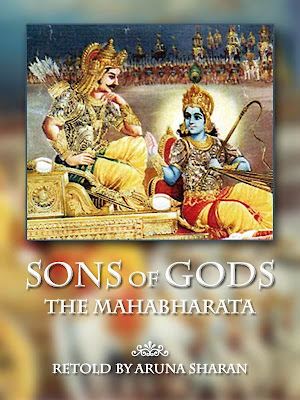
The Cover-- Revealed!

Image
C over design: Burke-Design Cover artist: Mu Ramalingkum Thanks to Laura Burke for donating this beautiful cover design! About the Mahabharata The central story of The Mahabharata is straightforward: it’s the age-old theme of good against evil, culminating in a cataclysmic war, the Battle of Kurukshetra. On the “goodie” side are the Pandavas: five brothers “like the five fingers of one hand”, each of them sired by a god, for their mother (and step-mother), Kunti, possesses a powerful Mantra that can summon such a divine being to father her children. The eldest Pandava is Yudhisthira, a paragon of a king. He is everything the world has ever longed for in a leader: just, unselfish, benevolent, upright, peace-loving, yet, if called for, a great warrior. But is he also weak? When he is cheated out of his kingdom by his arch-enemy, his wicked cousin Duryodhana, he dithers, unsure of the ethics of war, and it takes his warrior brothers as well as Krishna, the Incarnation...